

In December 2014, a few weeks before Christmas, Robert Prevost stood in a modest hall in Chiclayo, Peru, holding a handheld microphone, and sang “Feliz Navidad.” A handful of young people stood behind him with a guitar. The fluorescent lights were doing him no favors. He was fifty-nine years old, a Chicago kid by birth, a missionary by vocation, the newly appointed Apostolic Administrator of a dusty diocese on Peru’s northern coast. In the video, which is still on YouTube, he swayed slightly off the beat. He smiled. He meant it.
That is the man Donald Trump is picking a fight with this week.
Most Americans know him now as Pope Leo XIV, the first American pope, elected last May. What they may not know is the man underneath the title. When the La Leche River overflowed its banks in 2017 and cut off entire neighborhoods, Robert Prevost showed up in a pickup truck with boots and a poncho and helped load aid kits himself. When the staff tried to stop him, he said, I’m here to help, to serve. When COVID hit and the hospitals ran out of oxygen, while speculators charged hundreds of dollars per tank and families suffocated in their homes, he raised money from local businesses and bought the diocese two oxygen plants. “Families were dying,” OSV News his Caritas director said later. “Thanks to Msgr. Prevost, we were able to provide free care to hundreds of families.”
That same year, as Chiclayo locked down, he walked across the city on foot carrying the Blessed Sacrament, so the people of his diocese would know their bishop had not abandoned them. He refused a personal driver and drove himself to remote villages along unpaved roads, hours from the cathedral, to say Mass for people who otherwise would not have had one. In the 1990s, living in community in Trujillo during the years of terrorism and dictatorship, he cooked pizza for his housemates because you couldn’t buy pizza in Peru. His birthday is September 14, and the parish had to block off an entire week for the celebrations, because every community inside the diocese wanted its own party.
A friend from his theology school days, Sister Barbara Reid, was asked this spring what he was actually like. She said: “He’s a person who immediately exudes kindness. He is very present to you, deeply pastoral, discerning, and trustworthy. You know that anything you say to him will be kept.”
This is the man preaching from the basilica of Saint Augustine in Algeria this week, on the second day of an eleven-day journey to Africa. He has given his life to the theology of the African saint whose basilica he now speaks from, the saint who argued that a war was justified only to protect the innocent. On February 28, the United States and Israel launched Operation Epic Fury. Pope Leo XIV said what the man who taught him what a just war looks like would have said. He called it unacceptable.
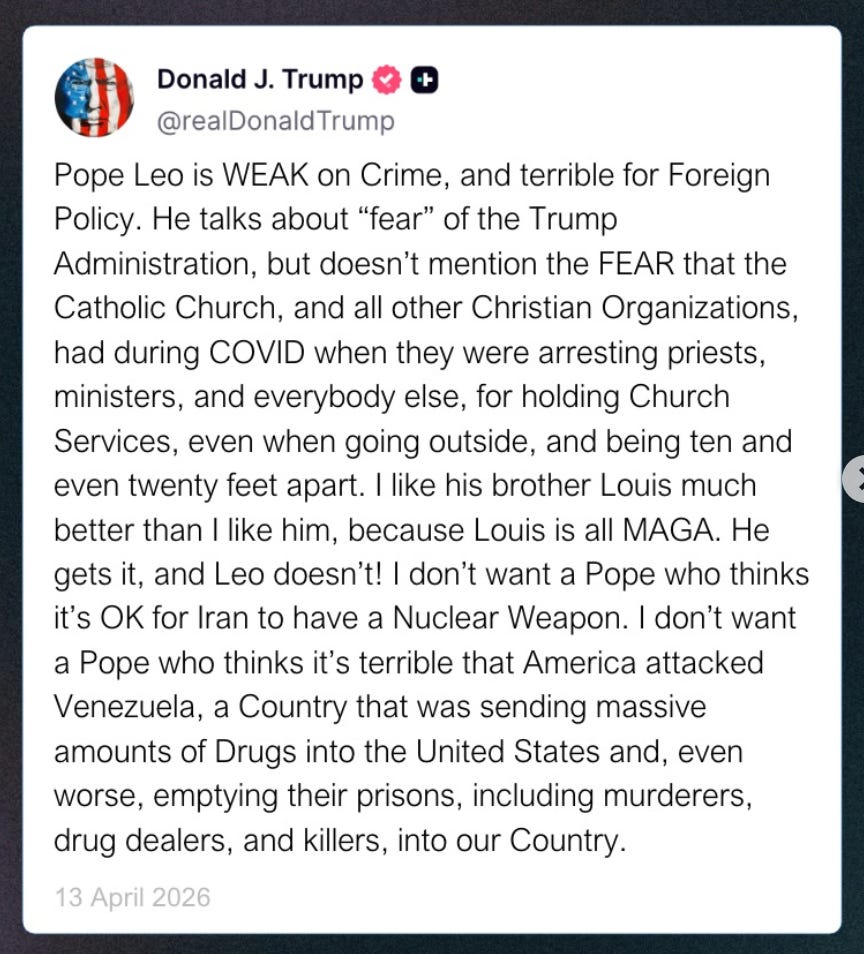
Trump called him “WEAK on Crime, and terrible for Foreign Policy.” He told reporters the Pope “said things that are wrong.” When Leo called the threat to annihilate Iran’s “whole civilization” unacceptable, Trump posted that he didn’t want a pope who “thinks it’s OK for Iran to have a Nuclear Weapon.” Then he posted an image of himself with Christ-like powers.

A former real estate developer, twice impeached, convicted of thirty-four felonies, has decided he outranks the man who carried the Blessed Sacrament across his locked-down city on foot so his people would not feel abandoned.
Then the Vice President joined in.
J.D. Vance, who was baptized Catholic in 2019, gave a Q&A at the University of Georgia in which he quoted a line Leo had posted on X — that God “is never on the side of those who once wielded the sword and today drop bombs” — and challenged it. “How can you say that God is never on the side of those who wield the sword?” Vance asked. “Was God on the side of the Americans who liberated France from the Nazis?”
Consider the specific absurdity. A recent convert, six years a Catholic, lecturing the first Augustinian pope, a man who spent half a century inside Augustine’s theology, who ran the seminaries that teach Augustine’s work, who is at this moment preaching inside the basilica named for Augustine — about what Augustine actually meant by just war. Vance is not saying Leo is wrong because of what the text says. He is saying Leo is wrong because Leo said it and Vance is Vance.
Even Giorgia Meloni, Italy’s far-right prime minister, Trump’s erstwhile ally, called the administration’s remarks unacceptable. The Iranian president rose to defend the Pope. The U.S. Conference of Catholic Bishops said it was disheartened. Trump has refused to apologize.
Eric Swalwell got away with what he was doing for almost twenty years.
A congressman, a prosecutor before that, a man who spent two decades in public life, with a staff, with donors, with reporters on his beat, with colleagues who saw him at every fundraiser and floor vote. For two decades, according to reporting in the San Francisco Chronicle, CNN, and NBC, he was allegedly sexually harassing, assaulting, and in at least one case raping the women around him.
How does a person do this for that long?
Not: how do they get away with it once. Not: how do they hide one bad night. How do they build a twenty-year career on top of it, rise through the ranks, chair committees, run for president, run for governor… with women in their twenties rotating through the office every cycle, each one a potential witness, each one a potential story, and none of it touching him until April of 2026?
I’ve been in a similar situation to those women. Not with Swalwell, whom I’ve never met, but with men like him. In D.C. over the years there were enough incidents that I stopped counting them as incidents and started counting them as weather.
January 2009. I was in DC for Obama’s inauguration, trying to get hired into the administration. I had dinner with a rising star of the labor movement, a man whose work has since made a real difference for American workers. I woke up in his hotel room the next morning, covered in bruises, dark marks climbing my neck, with no memory of how I got there.
Fall of 2011. I was running a progressive advocacy nonprofit. A board member demanded I come to his hotel room to talk. Once I was there, he tried to demand sex. He got physical. I got out, and I sent the board chair an email laying out what had happened. He never responded. His administrative assistant told me later she had been horrified by what happened to me, and horrified he never responded. When I eventually left DC and moved back to Washington State, I had to block the harassing board member’s email, phone number, and Facebook.
Netroots Nation, between those two dates. I had brought together a group of progressive bloggers with a sitting member of Congress and some of his staff. I got stuck sitting next to him at dinner. He was drunk, and he spent the meal trying to put his hand on my thigh. Afterwards one of the bloggers, a woman who was a friend of mine, came up to me, very concerned, and asked if I was all right. Her male boss was at the table right next to her. He had not noticed anything was happening.
I never reported any of it. I couldn’t. I didn’t work for the union, or for Congress, or for any of these men. There was no HR department somewhere with my name on a file. The only place I could have gone was the police, and I was acutely aware that filing anything would not lead to consequences for those men. The only thing reporting would have accomplished was to end my career.
The reason women don’t come forward isn’t fear of being disbelieved, exactly. It’s the math. The system is not designed to weigh the evidence, it is designed to weigh the people, and you are not the heavier one.
The women who spoke about Swalwell this month understood the math. One of them said she didn’t report the assault because she believed him when he told her he hadn’t made advances toward other women. She was wrong. There were many other women. But her calculation — his word, his reputation, his platform, against hers — was the same calculation I made in 2009, in 2011, and at that Netroots dinner.
Swalwell’s first statement after the Chronicle story was the tell. “For nearly 20 years, I have served the public — as a prosecutor and a congressman and have always protected women.”
Not “the evidence will show.” Not “I didn’t do this.” Look at my resume.
I am going to give this a name, because names matter.
A name is a tool. Once you have a word for a thing, you can see it in a way you could not see it before. For decades in this country there was no phrase for what happened to women at work — the hand on the thigh, the closed door, the veiled threat. Women knew what was happening. They did not have a word for it. In the 1970s, a group of feminists at Cornell coined one: sexual harassment. The behavior did not change overnight. But from that moment on, you could point at it. You could tell a friend what you meant in two words instead of twenty. The name gave women a handle on a thing that had been, until then, too slippery to hold.
The philosopher Miranda Fricker has described one small piece of what I am about to describe, what she calls testimonial injustice, the harm of having your credibility discounted because of who you are. Her analysis is precise and true, and I am in her debt. But the thing I am describing is bigger. It is not only that certain speakers are believed less. It is that in the system we actually live in, status has been substituted for evidence altogether. The question is no longer what is true. The question is who is allowed to be right.
I call this status-based reasoning.
The high-status person is right because they are the high-status person. Arguments are window dressing. Evidence is decoration. The conclusion is fixed before anyone opens their mouth, and everything that follows is the retroactive assembly of a justification.
Once you have the name, you can see it everywhere.
In 2005, on the first episode of The Colbert Report, Stephen Colbert named an earlier, softer version of this thing. He called it truthiness: the quality of seeming true, feeling true, being true for people who go with their gut rather than their books. “I don’t trust books,” he said, in character. “They’re all fact, no heart.”
Colbert meant it as a joke. Sort of.
Truthiness still implied sincerity, a person consulting her gut and reporting back. What we have now is colder. Truthiness was the caterpillar. Status-based reasoning is what crawled out of the cocoon.
For my entire life I have been told that American politics is a fight between left and right, safety net versus personal responsibility. I have understood for a long time that wasn’t the right way of thinking about it. I spent years in Washington watching arguments about all kind of things — the Affordable Care Act, the Iraq War, about who deserved credit for what in which meeting — collide with something that had nothing to do with the argument, and evaporate on contact. The left-right frame explained the surface. It did not explain why, underneath, the debates refused to behave like debates.
The real fight is epistemological. It is over how we decide what’s true. And one of the two answers currently on offer is: whoever has the higher status wins.
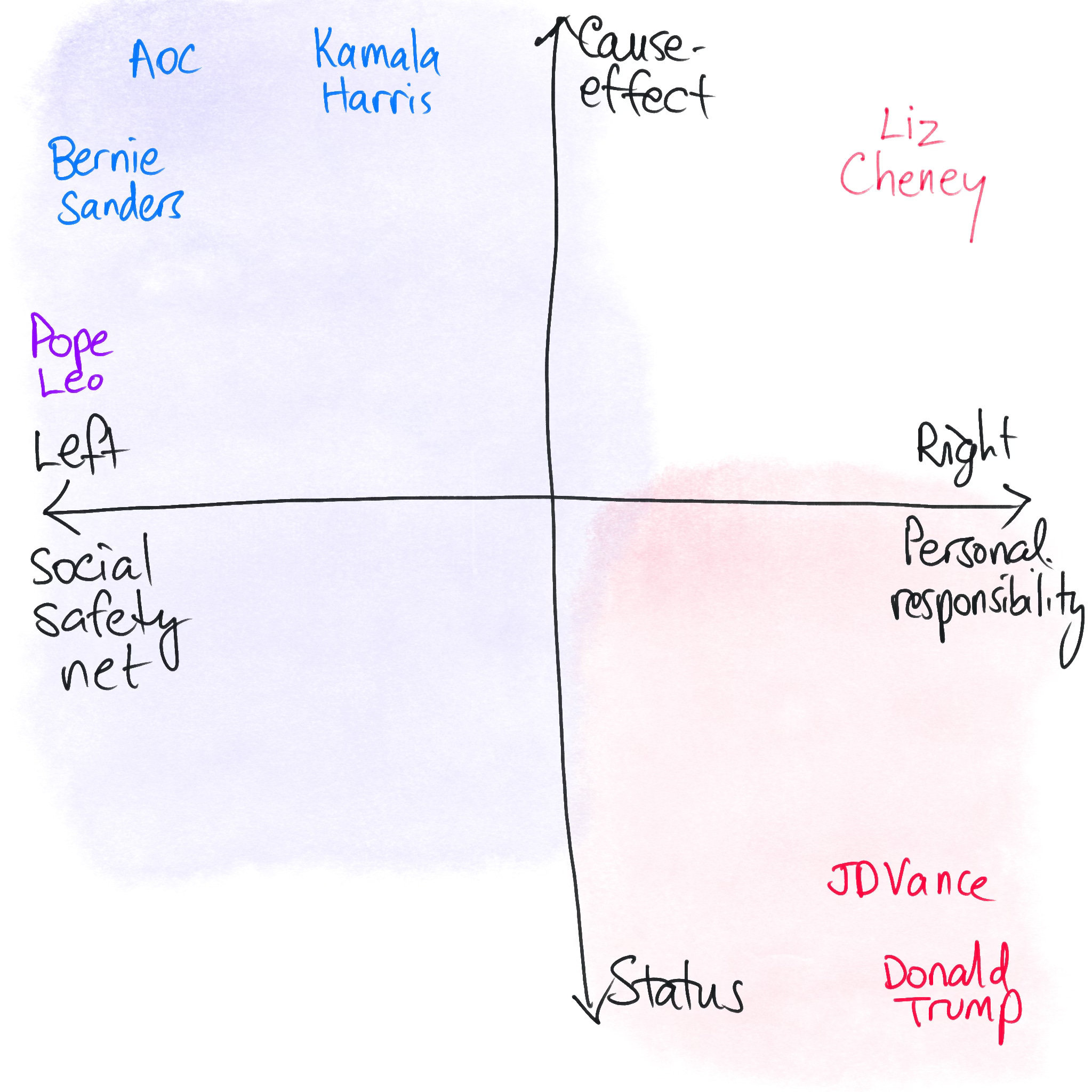
The Netroots dinner table and the Oval Office run on the same logic. A congressman’s word outranks a staffer’s word, so the staffer’s word doesn’t count, so the congressman’s word doesn’t have to be true. Once that math is stable, you can build a career on top of it. You can build a movement on top of it.
October 26, 2024. State College, Pennsylvania. A rally.
Donald Trump tells the crowd that Kamala Harris “would get us into a World War III guaranteed because she is too grossly incompetent to do the job.” He warns them that their “sons and daughters will end up getting drafted to go fight for a war in a country that you’ve never heard of.” He repeats it at rally after rally. On Truth Social: “There will be no future under Comrade Kamala Harris, because she will take us into a Nuclear World War III.”

February 28, 2026. Sixteen months later. Operation Epic Fury, launched in the early hours of the morning with joint U.S. and Israeli airstrikes on Iran. Three American soldiers dead in the first weeks. The exact scenario Trump had spent a year promising his opponent would trigger, executed by his own hand, six weeks after he took the oath.
The rest of it, he also did.
He had called Harris an “incompetent socialist lunatic” who would keep “breaking our economy for four more years.” Inflation, which had cooled to 2.5 percent under Biden-Harris, began climbing again under Trump. Sixteen Nobel laureates in economics had signed a letter warning that his plans would reignite inflation and likely trigger a recession. Sixty-eight percent of economists in a Wall Street Journal survey said prices would rise faster under him than under her. Moody’s projected his presidency would cost the economy over three million jobs compared to a Harris term. The economists were right.
He had warned that Harris would weaponize government against her enemies. He did. He had warned she would hand out favors to her friends. He did. He had warned she would appoint unqualified cronies. His cabinet is a master class in the form.
Every major prediction he made about her turned out to describe him.
In a world that ran on cause and effect, this would end a political career. The predictions failed. The warnings described the warner. The evidence is one-sided to a degree that rarely happens in politics.
In a world that runs on status, none of it registers. He is the high-status figure. She was the low-status one. He is right because he is the one who gets to be right.
This is why fact-checking doesn’t work on this movement. If your opponent’s authority rests on evidence, showing the evidence is wrong defeats them. If their authority rests on status, counter-evidence isn’t rebuttal. It’s insubordination. The response isn’t “let me reconsider.” It’s “how dare you.”
It’s why “believe women” became such a flashpoint. The slogan was never asking for women to be believed without evidence. It was asking for women’s evidence to be weighted the same as men’s. To remove the status discount from the scale. That modest request was heard as revolutionary, because it was. Removing the status discount changes who wins.
It’s why Trump could tell a rally crowd, in 2018, “just remember: what you’re seeing and what you’re reading is not what’s happening.” The evidence of your senses is lower-status than my assertion.
Don’t believe your lying eyes.
The crazy-making quality of living inside this system, on the wrong side of the line, is that the argument is never actually about the argument.
You can be right. Demonstrably. Documentably. On-the-record right.
You will lose anyway.
And then you will be told the problem is the quality of your reasoning, or the tone of your delivery, or your failure to build consensus. The goalposts move because the goalposts were never the point. The point was that you were going to lose, and the explanation would be assembled afterward.
This is what the Swalwell staffers lived inside. This is what Harris lived inside for the entirety of the 2024 campaign. This is what every woman who ever kept furniture between herself and a powerful man has lived inside her whole working life. This is where Donald Trump is trying to put Pope Leo.
Cause-and-effect reasoning is harder than it sounds. It demands that evidence be admissible regardless of who produces it. That predictions be checked against outcomes. That status be understood as something you earn by being right over time, not something that grants you the right to be correct in the moment. Most of all, it demands that the powerful change their minds when the facts contradict them. That is exactly what status-based reasoning was built to avoid.
It is also the only path that gets us to the truth. About inflation. About a war. About the man at the dinner table. About the four women with medical records and text messages who spent years being told, by the silence around them, that their story wouldn’t outrank his resume.
The fight over which axis governs is older than our parties, and it will outlast them. But right now, in 2026, one of our parties has openly committed itself to the status-based side of the line, and the other has not. Pretending otherwise is not balance. It’s capitulation dressed up as fairness.
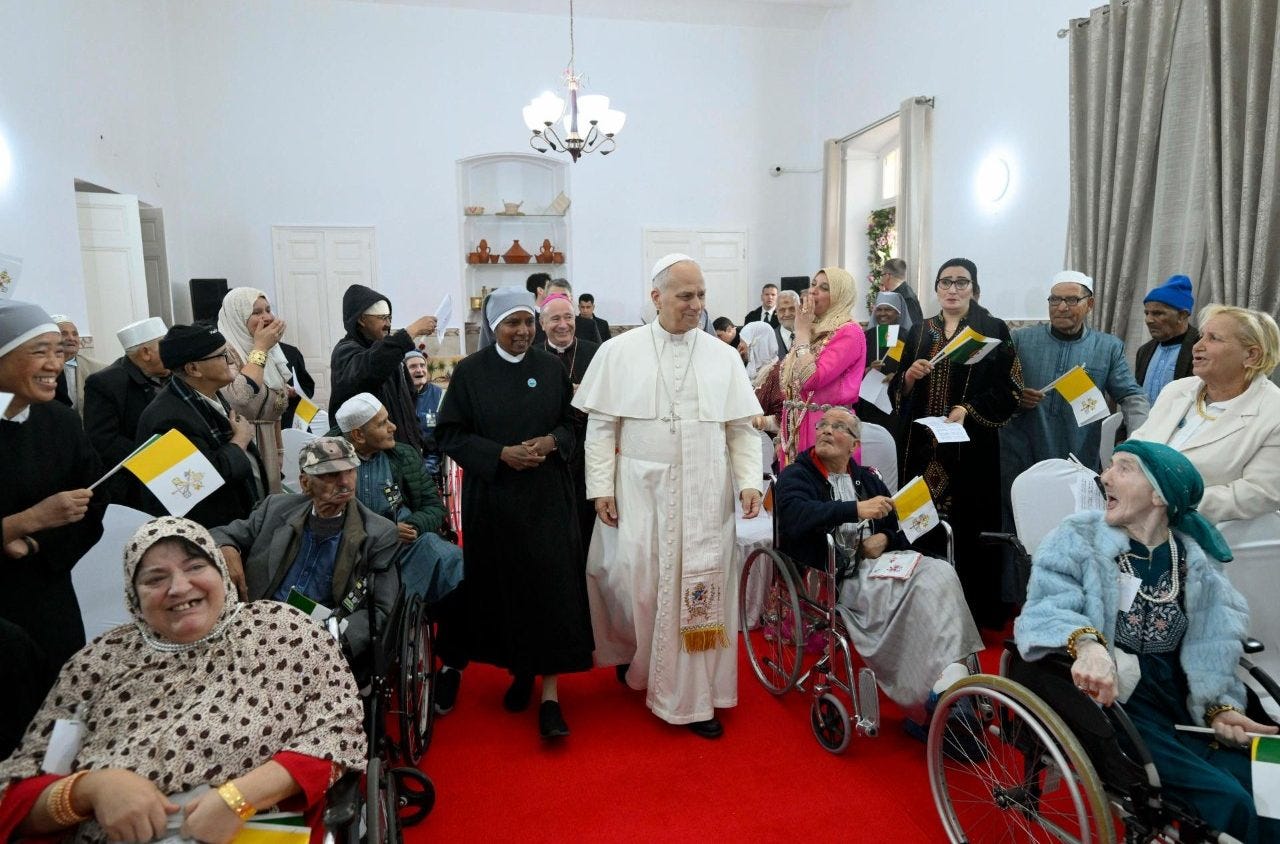
As I write this, Pope Leo XIV is in his fourth day in Algeria. He has visited a nursing home in the port city of Annaba, run by the Little Sisters of the Poor, and spent time with the elderly residents. Speaking to them, he said what he came there to say. “God’s heart is torn apart by wars, violence, injustice and lies. But our father’s heart is not with the wicked, the arrogant or the proud.”
The man he was describing was, at that moment, in the White House, refusing to apologize.
He has never in his life encountered a room he did not assume he owned.